
Spanish citizenship by descent: the grandchildren law and option
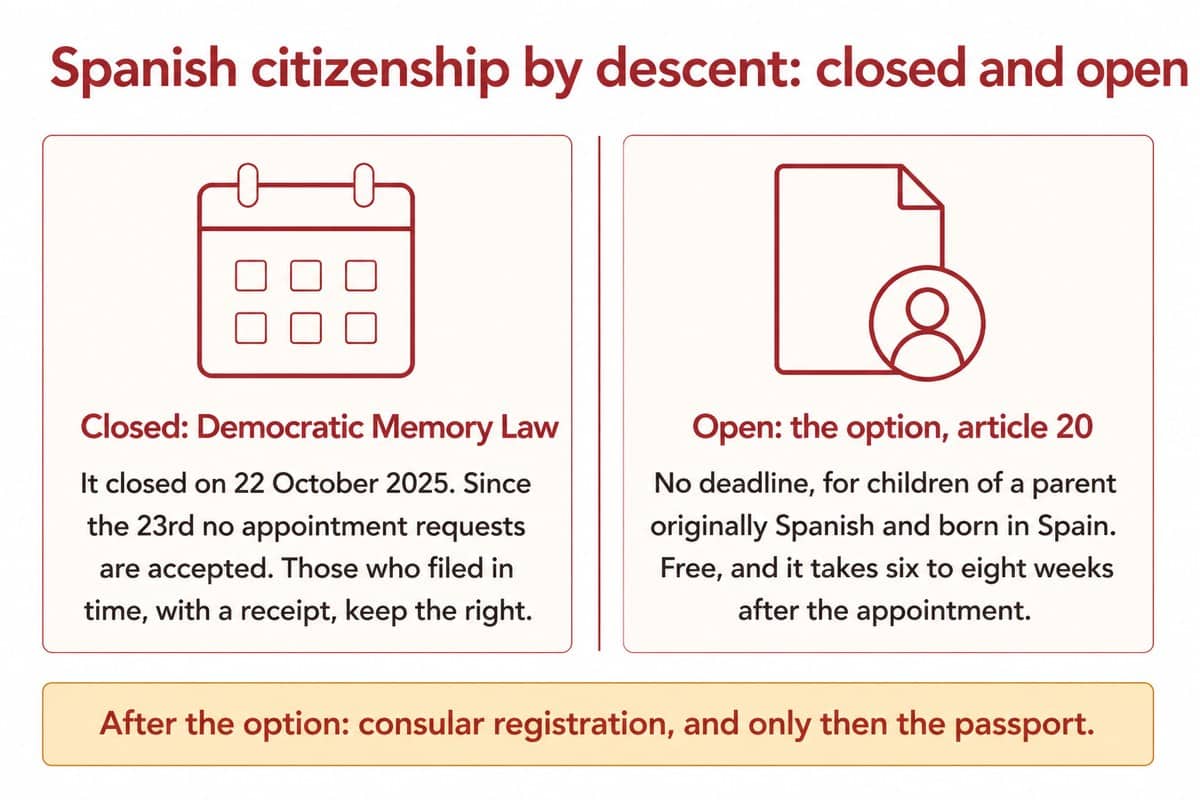
Start with the date, because it changes everything: the Democratic Memory Law closed on 22 October 2025. From the 23rd no appointment requests are accepted, whatever your case, and that includes anyone who has just discovered their grandmother was Spanish.
What remains open is something else, and for many people it is better: the option under article 20 of the Civil Code, which has no deadline.
If you filed in time
Anyone who registered before 23 October 2025 and got a receipt keeps the right. Offices send out credentials with no expiry date to choose a day and time, and slots open four times a week, five months ahead.
There are discipline rules worth knowing: one person, one appointment, no third-party registrations, missing your slot means two months before you can request another, and two cancellations disable the account. Consular staff cannot move appointments, and emails asking them to are discarded.
The route that is still open: option
You can opt for Spanish nationality, with no deadline, if you have a parent who was originally Spanish and born in Spain. That is the door left for most descendants in the United States, and it does not depend on any temporary law.
Other cases carry deadlines: someone who was under the parental authority of a Spaniard has two years from adulthood —in practice, until twenty— and someone whose parentage or Spanish birth is established after eighteen has two years from then.
| Item | Detail |
|---|---|
| Democratic Memory Law | closed 22 Oct 2025 |
| Option, art. 20 CC | open, no deadline |
| Cost | free |
| Registration time | 6-8 weeks |
| Renunciation | yes for US nationals |
- Long-form birth certificate from the Department of Health
- Valid foreign passport
- Proof of residence in the district
- Full birth certificate of the Spanish parent, less than a year old
- The parent’s naturalization certificate, if there was one
- Everything scanned into a single PDF
The renunciation, which surprises Americans
When you opt you must swear or promise loyalty to the King and obedience to the Constitution, and also declare that you renounce your previous nationality. Exempt are children under 14 and nationals of Ibero-American countries, Andorra, the Philippines, Equatorial Guinea, Portugal, France, and Sephardic Jews.
The United States is not on that list, so an American does make that declaration before the consul. It is a declaration for the purposes of Spanish law; what the United States makes of it is a matter for US law.
The documents, and where people fail
For the applicant: long-form birth certificate from the Department of Health —not the hospital's—, a valid foreign passport and proof of residence in the district, such as a driver's license or a lease.
For the Spanish parent: a full birth certificate less than a year old, their US naturalization certificate if there was one, and copies of their passports. If they married, the marriage certificate.
Everything goes first as a scan in a single PDF to the consulate's Civil Registry address; emails with the documents split across files or in another format are not reviewed.
Timing and cost
Registration and issuing the certificate take six to eight weeks after the appointment, depending on the office's workload. And there is good news: every Civil Registry procedure is free.
Once the option is registered, next comes consular registration, and only then can you apply for a passport. That is the order, and it cannot be skipped.
The option for children of a Spaniard born in Spain has no deadline: that door is still open.Details verified on 8 September 2026.
This directory is run privately. consuladosespana.us does not belong to the Ministry of Foreign Affairs or to any consular office.
We publish what the official sources say and point out where they disagree. Before traveling, check the detail with the office.